
Inside a commercial scent diffuser: what makes one last
From the outside, most commercial diffusers look alike: a sleek box, an app, a promise of luxury. The difference is inside, in parts most buyers never see and only discover when something fails. After years of installing, servicing and rebuilding systems across the UAE, this is what we have learned about building one that lasts.
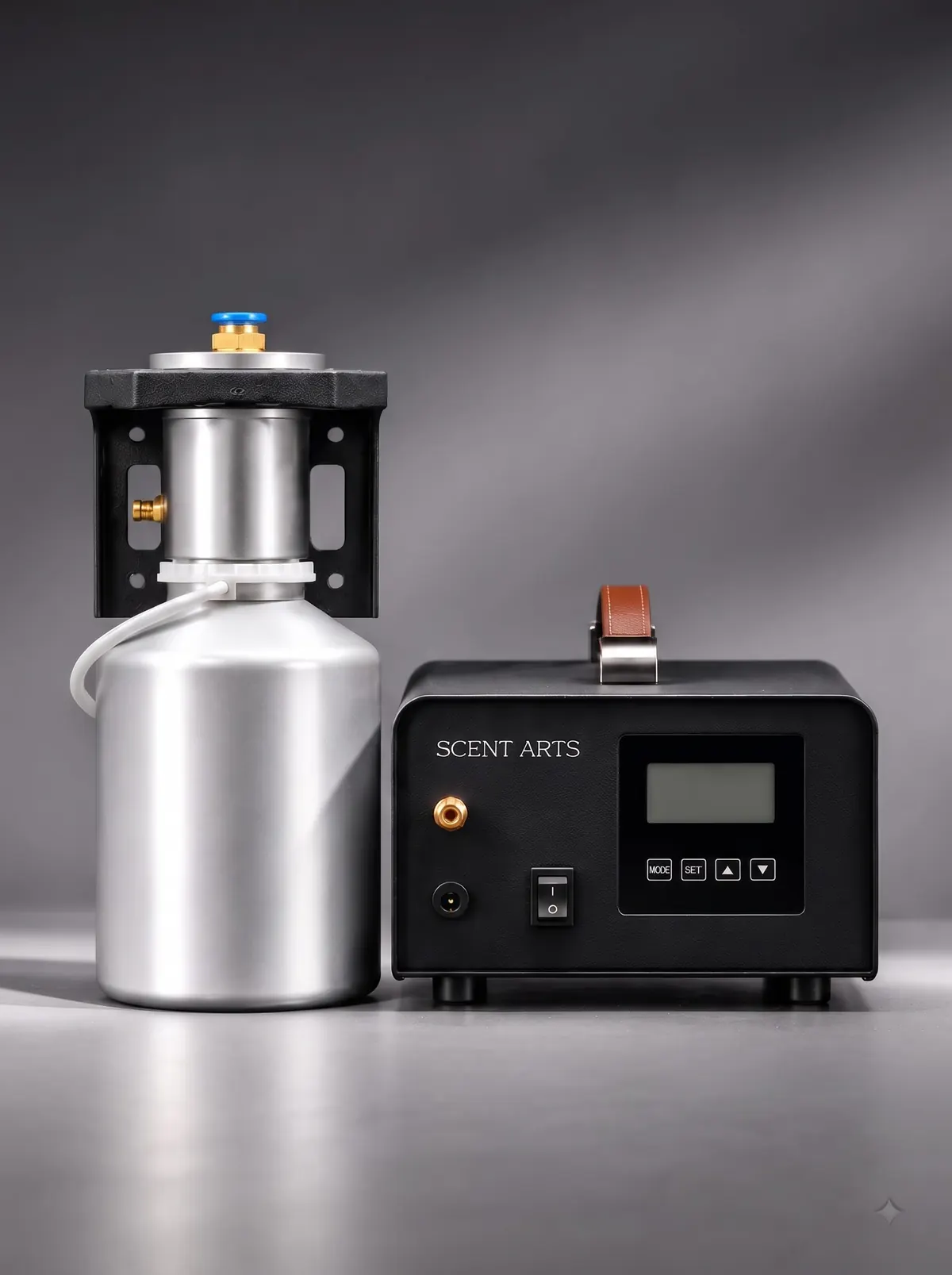
- The atomiser core is the heart of a diffuser, and it only performs with oil of the right viscosity.
- In still rooms, diffusion alone is not enough: the scent has to be carried.
- HVAC scenting is safe when output is calibrated and scheduled to the air system.
- The best hardware still fails without scheduled service.
How a cold-air diffuser works
A commercial cold-air diffuser, also called a nebulising diffuser, uses a small air pump to push air through an atomiser. As the air passes through, it draws fragrance oil up and breaks it into a very fine mist. There is no heat, which would change the fragrance, and no water, which would dilute it and add humidity. The mist is then released into the room or into the building's air system.
1. The atomiser core
The atomiser is where the oil becomes mist, and it is engineered to very fine tolerances. That is why it is the part most sensitive to what goes through it.
2. Oil viscosity: why the oil must match the machine
Viscosity is how thick or thin an oil is. Every atomiser core is built for a specific range:
- Too thick, and the oil cannot be drawn up and broken into mist properly. It clogs the core, output drops and the diffuser can be damaged.
- Too thin, and the system can over-diffuse, using oil faster and making the space too strong.
At Scent Arts, our fragrance oils are blended to the exact viscosity our atomiser cores are built for. That is why we always recommend using our own fragrances in our diffusers: we have tested them together. Other oils, or oils of a different thickness, can damage the system.
3. Throw: diffusing the scent is only half the job
In our test rooms and on site, we found that a diffuser can produce perfect mist and still leave a room unevenly scented. Scent needs air movement to spread. With good circulation, from air conditioning or natural airflow, it travels well. In a still room, it stays close to the unit.
So we added a built-in fan to our larger models. It does not just release the fragrance; it carries it across the space, with adjustable settings and grades for different room sizes. Smaller models, used in compact rooms, do not need one.
4. The pump
The pump is what drives the whole system: it creates the airflow that turns oil into mist, every hour the diffuser runs. A weak pump means falling output and early failure. That is why our diffusers use a specially configured pump made in Germany, assembled into our systems at our own facility in China, chosen for a long, reliable working life in commercial spaces that run every day.
In average conditions, our pumps last around three to five years. In dusty locations they work harder, which is why every diffuser also has a built-in filter, and why pumps and filters are checked, and replaced when needed, as part of our maintenance.
5. Quiet by design
A diffuser in a lobby, spa or boardroom must never be heard. Our systems run below 40 dB, and our Studio below 35 dB.
6. Safe with your HVAC
When a diffuser is connected to the air conditioning, the question every facilities manager asks is whether oil can build up in the system. Good HVAC scenting avoids it by design:
- the diffuser releases a fine mist, not liquid;
- output is calibrated to the volume of air the system moves;
- scenting runs only while the air handling is on, never into still ducts;
- connection points are chosen during the site assessment and inspected on every service visit.
One rule matters more than any other: distance. We always install the diffuser and its oil outlet less than one metre from the duct. Over a longer run, the mist can condense back into liquid before it reaches the airflow, which can damage the diffuser and stop the scent from reaching the space. We also watch for problems that start in the air conditioning itself, such as water leaks or humidifier faults, where water could mix with fragrance. Our technical team checks for these on every visit. If we find one, we tell the client straight away and switch the diffuser off until the AC is repaired.
7. Built for the Gulf
UAE spaces bring their own challenges: high outdoor heat, air conditioning running long hours, and above all dust. In a desert climate, fine dust finds its way into every machine, so our diffusers have built-in filters, and we check and change them during maintenance before dust can affect the pump or the output. At beachfront hotels, resorts and villas, the challenge is the air itself. Coastal air feels and smells different from inland air: softer, saltier and full of the sea. A heavy, inland-style fragrance can feel out of place there, as if it is fighting the setting. So for coastal properties, we recommend scents with a connection to water: aquatic and marine accords, sea salt, fresh citrus, airy florals and light driftwood notes that feel like a natural extension of the beach outside. From the Palm to Saadiyat, the right coastal scent makes the lobby feel like it belongs to the shoreline.
8. Smart control and monitoring
Every system runs on programmable schedules with remote intensity control and consumption monitoring. Under our annual maintenance contract, our team sets and monitors every diffuser in our software, so problems are caught early, and a diffuser can be switched off remotely at once if ever needed.
9. Engineered by us
Our diffuser technology is developed in our own facility in China, and every oil is formulated and tested in our labs in the UAE, Switzerland and France. Designing both the machine and the fragrance means we can build them to work together.
10. Service: the part that decides everything
Even the best diffuser drifts over time. Atomisers need cleaning, output needs recalibrating as seasons and footfall change, and oil needs refilling before it runs out. Small parts matter too: we check every system for leaks, replace filters, and change washers regularly, because a worn washer lets air escape and quietly reduces performance. When a pump reaches the end of its life, we replace it during maintenance, before it fails. That is why every Scent Arts system is serviced on schedule, mostly monthly, with oil sized to last 30 to 35 days.
What to ask any supplier
- Are your oils blended for your diffusers?
- How do you carry scent in rooms with weak airflow?
- How do you prevent oil build-up in HVAC systems?
- How quiet is the system, in decibels?
- Who services it, and how often?