
HVAC or standalone diffusers: which is right for your space?
It is the first technical question in almost every consultation: should the scent go through the air conditioning, or should the diffuser sit in the room? The honest answer is that most great spaces use both. Here is how to decide, zone by zone.
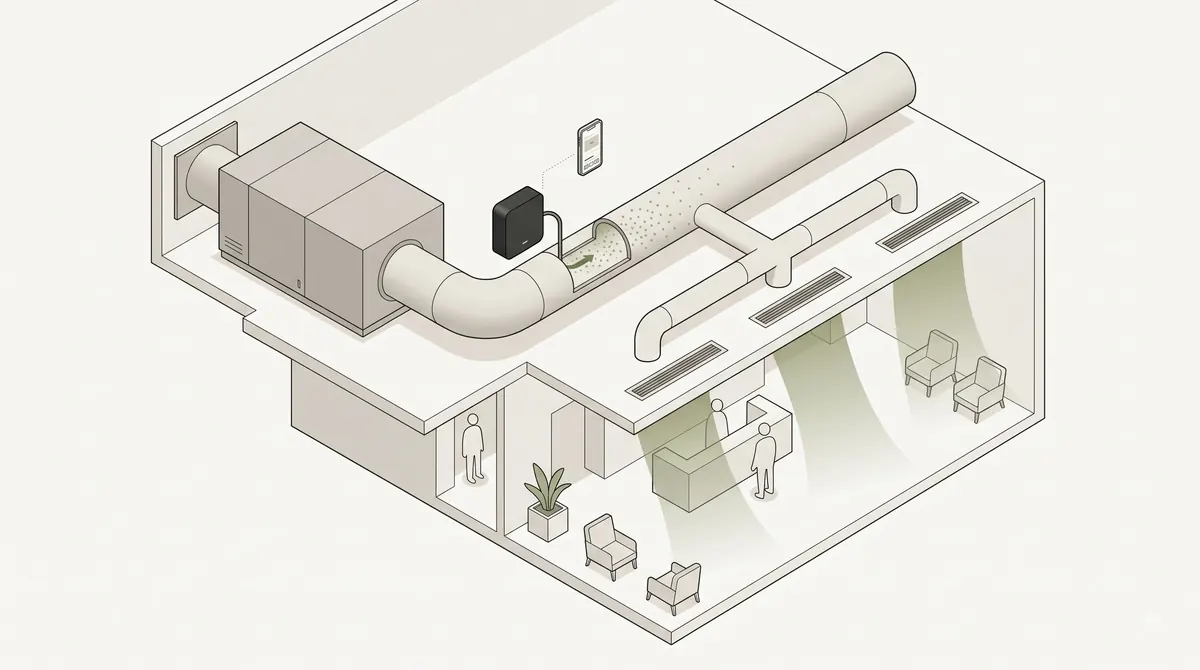
- HVAC-direct systems scent large areas invisibly through the building's air conditioning.
- Standalone systems, wall-mounted or freestanding, scent one zone and need no HVAC access.
- The right choice depends on airflow, size, visibility and how the space is used, not on price alone.
- Most hotels, malls and offices combine both: HVAC for the big spaces, standalone units for the rooms the ducts don't reach.
What is an HVAC scent diffuser?
An HVAC scent diffuser connects to your building's heating, ventilation and air-conditioning system. It releases a fine, dry fragrance mist into the air handling unit or ductwork, and the building's own airflow carries the scent through the vents into every connected space.
Best for: hotel lobbies and corridors, malls, office towers, multi-floor buildings, large flagships, and any client who wants no visible hardware at all.
What is a standalone scent diffuser?
A standalone diffuser sits in the space it scents. It can be wall-mounted, fixed high and discreet, or freestanding, placed on the floor or a counter and moved as needed. It does not rely on the building's air system.
Best for: boutiques, restaurants, washrooms, spa and treatment rooms, lifts, sales galleries, show units, events, and any space without HVAC access.
Side by side
| HVAC-direct | Wall-mounted | Freestanding | |
|---|---|---|---|
| Coverage | Building-wide or by zone | One zone | One zone or area |
| Visibility | None in the space | Minimal, mounted high | Visible, designed to suit interiors |
| Installation | 1 to 2 hours per unit | Up to 45 minutes per unit | Minutes, no installation work |
| Needs | HVAC access and airflow during scenting hours | A wall and, for most units, a power point | A level surface; battery models need no socket |
| Ideal for | Hotels, malls, towers | Washrooms, boutiques, spa rooms | Events, show suites, receptions |
Five questions that decide it
1. Is there HVAC access, and does it run during your hours?
An HVAC system can only carry scent while its fans are running. If the air handling switches off at night or cycles on and off, scenting has to be scheduled around it. If the ducts are shared with other tenants, as in many mall units, HVAC-direct may not be possible at all.
2. How big and how open is the space?
Large, open volumes such as atriums and lobbies are where HVAC scenting is at its best. Smaller, enclosed rooms are often better served by a standalone unit placed exactly where it is needed.
3. How much should be visible?
Some brands want no hardware in sight. Others are happy for a well-designed unit to be part of the interior. Visibility is a design decision as much as a technical one.
4. How does air move in the room?
Scent needs air movement to spread. In a still room with weak circulation, even good fragrance will pool near the unit. That is why our larger models carry a built-in fan with adjustable settings, to carry the scent across the room where airflow is weak.
5. Is it permanent or temporary?
For events, launches, show suites and pop-ups, freestanding systems are placed in minutes and removed just as quickly.
Is HVAC scenting safe for your air system?
It is a fair question from every facilities manager. When it is specified and calibrated properly, HVAC scenting is designed to work with your air system, not against it:
- The diffuser produces a dry micro-mist, not liquid, so fragrance travels as fine particles in the airflow.
- Output is calibrated to the volume of air, so the system releases only what the space can carry.
- Scenting is scheduled to the hours your air handling runs, so fragrance is never released into still ducts.
- Connection points are chosen during the site assessment, with the oil outlet less than one metre from the duct.
- Our team inspects connection points on every service visit.
Distance is critical. We install the diffuser and its oil outlet less than one metre from the duct, because over a longer run the mist can condense back into liquid, which can damage the diffuser and stop the scent reaching the space. And if the air conditioning itself develops a problem, such as a water leak or a humidifier fault, our technical team flags it, informs you and switches the diffuser off until it is fixed.
Why most spaces use both
A typical five-star hotel might run HVAC scenting through the lobby, corridors and lifts, then add wall-mounted units in washrooms and the spa, and a freestanding unit at a poolside reception. The result is one consistent scent everywhere, delivered in the right way for each space.
Questions
- Can HVAC scenting cover a whole building?
- Yes, where the air handling serves the whole building. Large properties are usually split into zones so each area gets the right intensity.
- Will HVAC scenting damage our air conditioning?
- When correctly specified, calibrated and scheduled to run while the air handling is on, it is designed to work safely with your system. Ask your supplier how they calibrate output and inspect connection points.
- Can we scent a mall unit through the HVAC?
- Often not, because mall units usually share central air handling. Wall-mounted or freestanding units inside your store are the usual answer.