
How a signature scent is created, from brief to bottle
A logo takes a second to see. A signature scent takes a second to feel, and much longer to forget.
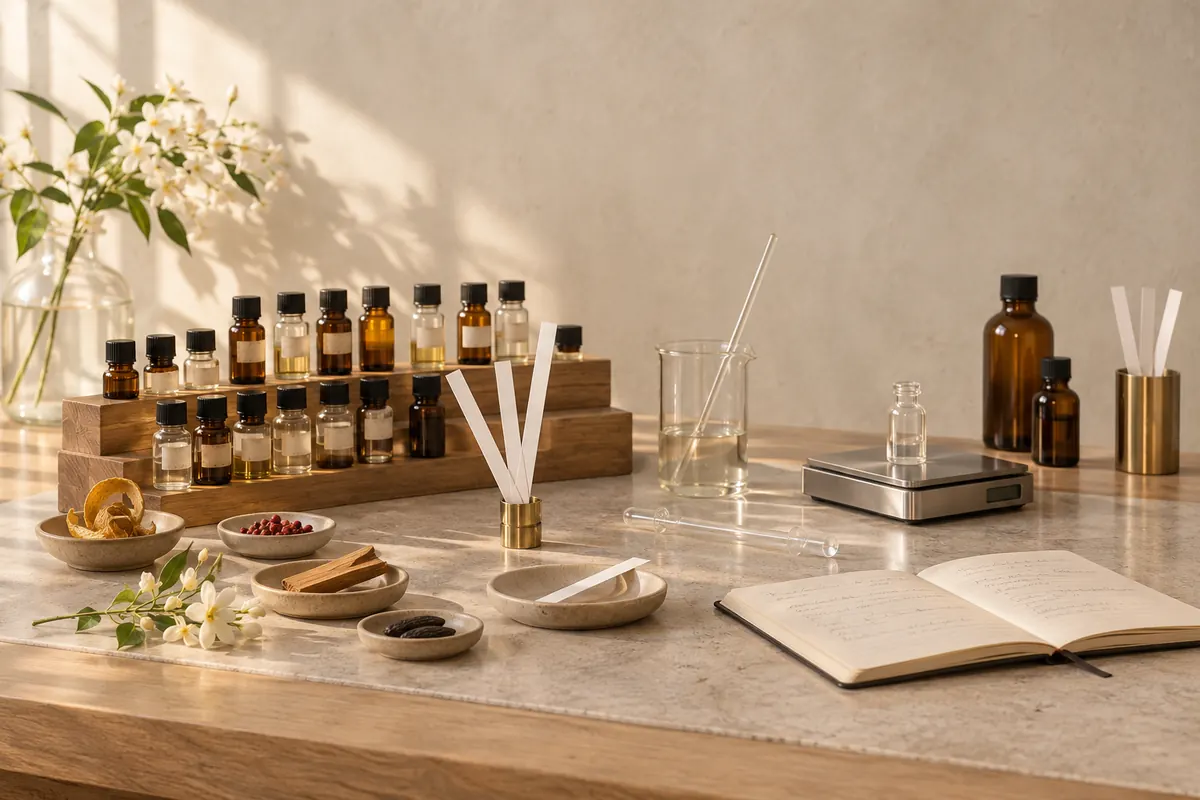
- A signature scent is a fragrance composed exclusively for one brand.
- It starts with your brand and your spaces, not with notes.
- Creation typically takes four to six weeks from brief to approved fragrance.
- It should be tested in your space, not just on a paper strip.
- You should receive full safety documentation and a clear agreement on exclusivity or IP.
What is a signature scent?
A signature scent is a fragrance created for one brand alone and used consistently across its spaces, products and gifts, so people come to recognise the brand by scent. It works like a logo for the sense of smell: the more consistently it is used, the stronger the recognition becomes.
Library scent or signature scent?
| Library scent | Signature scent | |
|---|---|---|
| What it is | A fragrance chosen from a curated collection | A fragrance composed for your brand |
| Exclusive to you | No | Yes |
| Time to start | Days | Four to six weeks |
| Best for | Single sites, fast starts, seasonal changes | Brands building recognition across locations, products and gifts |
Many brands start with one of our 250+ library scents and move to a signature once they see the effect.
The five stages
1. Discovery
We begin with the brand, not the bottle. Who are your guests? What should they feel in the first ten seconds? Which words would you never want associated with you? We also walk the spaces where the scent will live, because a ventilated marble lobby and a quiet spa room ask for very different things.
2. Creative direction
Our perfumers translate the brief into two or three clearly different directions. Each is built from scent families, such as fresh, floral, woody, oriental or gourmand, and named notes, so you can compare ideas rather than vague descriptions.
3. Sampling in your space
This is the step many suppliers skip. A fragrance smells different in a lobby than on a blotter, because airflow, temperature, materials and people all change how it performs. You test the directions where they will be used, with the people who work there.
4. Refinement and approval
We refine the chosen direction until it feels right for the brand and performs in the air: noticeable at the door, comfortable over hours, consistent from room to room. Every signature scent is formulated and tested in our perfume labs in the UAE, Switzerland and France, using European-made materials.
5. Documentation and deployment
Once approved, we prepare the documentation, from the safety data sheet to IFRA compliance, and the scent goes into our systems across every location, and into products and gifts whenever you are ready.
How a scent is built: top, heart and base
Most fine fragrances are described in three layers:
- Top notes: the first impression, light and bright, such as citrus and fresh herbs.
- Heart notes: the character of the scent, such as florals, spices and teas.
- Base notes: the depth that lingers, such as woods, amber, musk and oud.
In a space scented through a diffuser, the whole composition is released together, so a signature scent for spaces is balanced to read as one clear idea in the air rather than a perfume that changes on skin over hours.
Who owns the scent?
This should be clear before you start. At Scent Arts, once a signature is developed, we sign an exclusivity agreement and store the formula securely: we own the fragrance, but it is made exclusively for you. If you need the complete formula in your name, a full IP transfer is possible after discussion and at an IP transfer cost.
Where a signature scent can go
- In your spaces: lobbies, showrooms, offices, spas, lifts and washrooms.
- In your products: candles, room sprays, reed diffusers and perfume.
- In your gifts: client gifts, handover gifts, VIP amenities and event giveaways.
Questions
- How long does it take to create a signature scent?
- Typically four to six weeks from the first brief to an approved fragrance, depending on how many refinement rounds you need.
- Can a group with several brands have different scents?
- Yes. Each brand can have its own signature, related or entirely distinct.
- Will anyone else be able to use our scent?
- No. Your signature is made exclusively for you under an exclusivity agreement.